



What Is Boxing Day? Meaning, Origins & Where It’s Celebrated
Key Takeaways
- Boxing Day is celebrated on December 26 (the day after Christmas), primarily in the United Kingdom and other countries with British and Commonwealth roots.
- The name “Boxing Day” comes from the tradition of giving Christmas boxes filled with money, food, or small gifts to servants, tradespeople, and the poor, as well as from church alms boxes opened to distribute donations.
- The main countries where Boxing Day is an official public holiday include the UK, Canada, Australia, and New Zealand, with other countries like South Africa and former British territories also observing the day.
- Modern Boxing Day is marked by major shopping sales (similar to Black Friday in scale), sporting events like Premier League football matches and horse racing, and relaxed family time enjoying leftovers like turkey sandwiches and turkey curry.
- Boxing Day evolved from a religious holiday honoring Saint Stephen (the first Christian martyr) into a secular tradition during Queen Victoria’s reign that blended charity, rest, and celebration.
What Is Boxing Day?

Boxing Day is a holiday celebrated on December 26, the day after Christmas, particularly in the United Kingdom and Commonwealth countries like Canada, Australia, and New Zealand. Despite what the name might suggest, this holiday has absolutely nothing to do with the sport of boxing or prizefighting.
The origins of Boxing Day are rooted in historical gift-giving and charity traditions dating back centuries. The “boxing” refers to Christmas boxes, which are containers filled with money, leftover food, or other gifts that were traditionally given to servants, tradespeople, and those in need.
In the modern era, Boxing Day functions as an extension of the Christmas holiday season. It serves as a legal public holiday in several countries, focused on rest, visiting relatives, watching sport on television, and engaging in post-Christmas activities like shopping.
In the UK and many Commonwealth nations, Boxing Day is a bank holiday, meaning offices, banks, schools, and many services are closed or operate on limited hours. This gives families an extra day to recover from Christmas dinner festivities and spend quality time together.
For those in the United States or much of Europe where Boxing Day is not an official holiday, some people still mark December 26 informally. These celebrations typically involve gatherings with friends, enjoying Christmas leftovers, and extending the festive atmosphere a bit longer.
When Is Boxing Day (Including Upcoming Dates)?
Boxing Day always falls on December 26, regardless of what day of the week that happens to be. The date itself never changes, though the way it’s officially observed as a bank holiday can shift depending on the calendar.
Here are some upcoming Boxing Day dates to mark on your calendar:
|
Year |
Boxing Day Date |
Day of the Week |
|---|---|---|
|
2025 |
December 26 |
Friday |
|
2026 |
December 26 |
Saturday |
|
2027 |
December 26 |
Sunday |
|
2028 |
December 26 |
Tuesday |
|
2029 |
December 26 |
Wednesday |
| 2030 |
December 26 |
Thursday |
In the UK and several Commonwealth countries, when Boxing Day falls on a weekend, the official bank holiday may move to the following Monday. If both Christmas Day and Boxing Day fall on weekend days, the observed holidays typically shift to the following Monday and following Tuesday.
For example, when Boxing Day falls on a Saturday, the substitute bank holiday is usually observed on the following Monday. When it falls on a Sunday, the bank holiday moves to the following Tuesday (since Christmas Day would take the Monday).
Despite these legal adjustments for the observed holiday, the cultural celebration and Boxing Day traditions generally still happen on December 26 itself. Families gather, leftovers are consumed, and the festive spirit continues on the same day each year.
Why Is It Called Boxing Day? (Origins of the Name)
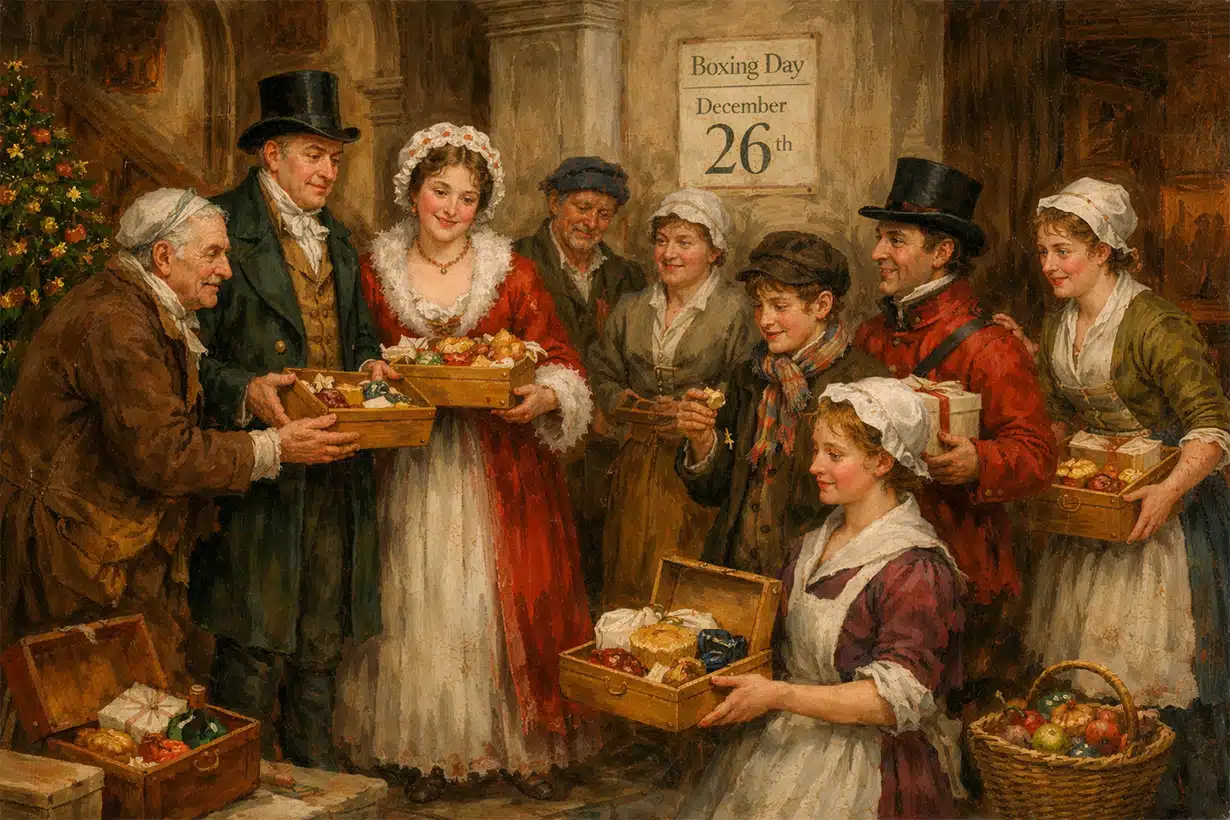
The name “Boxing Day” has puzzled people for generations, particularly those unfamiliar with British history. Understanding why it’s called Boxing Day requires looking back to Victorian Britain and even older Christian customs.
During the 18th and 19th centuries in Britain, wealthy families and employers prepared Christmas boxes to give to their domestic servants, tradespeople, and regular service providers on December 26. These boxes contained money, food, or small gifts as thanks for their service throughout the year.
The connection to church alms boxes provides another key piece of the puzzle. Churches traditionally collected donations in locked boxes throughout the Advent season or the entire year. These boxes were then opened around Christmas, with the contents distributed to the poor on the day after Christmas Day.
There’s also a practical reason why December 26 became the designated day for these gifts. Household servants typically worked on Christmas Day itself, serving elaborate Christmas dinner feasts to their employers and ensuring the holiday ran smoothly. In exchange, they received the following day off, along with boxed gifts and leftover food to take home to their own families.
Some historians point to a lesser-known nautical theory involving sealed money boxes carried on British naval ships as good luck charms. Upon safe return from voyages, these boxes were reportedly opened and the contents donated to charity, often on Boxing Day.
The first documented reference to servant gift-giving on this day appears in Samuel Pepys’ diary from 1663. The Oxford English Dictionary records the first printed use of “Boxing Day” in 1833, and Charles Dickens referenced the tradition in The Pickwick Papers shortly after.
The takeaway is clear: the “boxing” in Boxing Day refers exclusively to boxes of gifts or donations—not to punching, sparring, or any other fighting.
Historical Roots: From St. Stephen’s Day to Victorian Tradition
Boxing Day’s origins connect to deeper Christian and European traditions observed on December 26, most notably Saint Stephen’s Day.
December 26 is the Feast of Saint Stephen in the Christian calendar. Saint Stephen holds the distinction of being the first Christian martyr, stoned to death around 34 A.D. for his faith. He was known particularly for his care for the poor and his charitable works, making the date symbolically appropriate for a holiday centered on giving.
The popular Christmas carol “Good King Wenceslas” perfectly illustrates the spirit of Saint Stephen’s Day generosity. In the song, the medieval Bohemian king braves harsh winter weather on the Feast of Stephen to bring food and firewood to a poor peasant. The carol reinforced the connection between December 26 and charitable acts.
This religious emphasis on giving to the needy directly influenced the charitable tone that Boxing Day developed in Britain and Ireland. The Christian festival’s focus on almsgiving provided moral grounding for secular gift-giving customs.
The practice evolved significantly during Queen Victoria’s reign in the mid-19th century. The Victorian era saw the upper and middle classes systematize the giving of Christmas boxes containing money, leftover food, and small gifts to their domestic staff. Regular tradespeople who served households throughout the year—postmen, milkmen, chimney sweeps, and delivery workers—also received these tokens of appreciation.
The tradition became so established that the Bank Holiday Act of 1871 officially recognized Boxing Day as a bank holiday in the United Kingdom. Later refinements through the Banking and Financial Dealings Act of 1971 addressed how the holiday would be observed when it fell on weekends.
As the British Empire expanded, both the name “Boxing Day” and its customs spread to colonies and later Commonwealth countries. Local cultures blended the tradition with their own seasonal practices, creating the varied celebrations we see today.
Where Is Boxing Day Celebrated? Main Countries and Regional Variations
Boxing Day is most widely celebrated in countries with strong historical ties to Britain, especially members of the British Commonwealth. However, the way the day is observed varies significantly from nation to nation.
Core Boxing Day Countries
|
Country |
Status |
Typical Celebrations |
|---|---|---|
|
United Kingdom |
Bank Holiday |
Football matches, shopping sales, pub visits |
|
Canada |
Statutory Holiday |
Major retail sales, winter sports, family gatherings |
|
Australia |
Public Holiday |
Beach outings, barbecues, cricket matches |
|
New Zealand |
Public Holiday |
Outdoor activities, sales shopping, relaxation |
In the United Kingdom, Boxing Day is officially recognized as a bank holiday. The day traditionally held connections to aristocratic pursuits like foxhunting and horse racing in rural areas, though urban industrialization shifted focus toward professional football. Today, Premier League matches on Boxing Day draw massive crowds and television audiences.
Canada, Australia, and New Zealand all actively celebrate Boxing Day as a statutory holiday. Australians often head to beaches for barbecues and outdoor activities, while Canadians embrace winter sports alongside major shopping events. The servant-tip legacy continues through modern employee bonuses, typically given before Christmas.
Other Countries and Regions
Several other countries and regions observe December 26 in similar ways, even when using different names:
-
South Africa: Beach outings, sports events, and family gatherings mark the day
-
Caribbean nations: Jamaica, Trinidad and Tobago, and others feature calypso music, horse racing, and junkanoo festivals blending British and African influences
-
Hong Kong: Generally maintains the public holiday under local calendars from its British colonial history
-
Kenya, Uganda, Papua New Guinea: Among the 20+ countries recognizing the day as part of Commonwealth heritage
European Variations
In European countries like Ireland, Italy, Germany, and Hungary, December 26 is better known as St. Stephen’s Day or serves as a second Christmas day. The focus tends to be more religious or family-oriented rather than the Boxing Day label with its shopping and sports associations.
Ireland officially calls December 26 Saint Stephen’s Day, featuring traditional wren-boy processions in some areas. Germany and Austria treat it as a second day of Christmas focused on extended family gatherings.
Why the United States Doesn’t Celebrate
The United States does not have Boxing Day as an official holiday. This gap exists primarily because America gained independence long before Boxing Day became legally recognized in Britain during the 1800s. The tradition simply never became part of U.S. federal holidays or cultural practices.
That said, migrants and expatriate communities often continue Boxing Day-style gatherings in countries where it’s not officially recognized. These celebrations typically feature parties, games, and leftover feasts.
Modern Boxing Day Traditions: Shopping, Sports & Leftovers
Boxing Day has shifted considerably from its primarily charitable origins to become a blend of leisure, commerce, and sport. Yet the underlying spirit of generosity and community hasn’t entirely disappeared.
Boxing Day Sales

In the UK, Canada, Australia, and New Zealand, many retailers launch major post-Christmas discounts on December 26. These Boxing Day sales have become comparable to Black Friday sales in the United States, featuring:
- Long queues outside major department stores
- Doorbuster offers on electronics, clothing, and housewares
- Significant online deals for those who prefer to shop from home
- Deep discounts on items purchased as unwanted gifts being returned
The evolution into a shopping frenzy accelerated after changes to Sunday trading laws under John Major’s government in the late 1990s. What began as a day for charity boxes transformed into consumer bonanzas across celebrating nations.
In the 21st century, Black Friday promotions (especially in the UK and Canada) have slightly reduced Boxing Day’s dominance as the biggest shopping day. However, December 26 remains a key sales event, with many shoppers specifically waiting for post-Christmas clearances.
Sporting Events
Boxing Day holds a special place in the sporting calendar, with events traditionally held across multiple sports:
Football (Soccer): The English Premier League and lower divisions run a full programme of matches on Boxing Day. These fixtures draw massive attendance and television viewership, with clubs like Manchester United and other top teams competing in what has become a beloved tradition.
Horse Racing: Multiple race meetings take place across the UK on Boxing Day, continuing aristocratic sporting traditions from centuries past.
Cricket: In Australia and South Africa, Boxing Day often coincides with major cricket matches, including the famous Melbourne Cricket Club Test Match.
Rugby: Various rugby fixtures round out the sporting slate in the UK and other countries.
Family Time and Relaxation
Many people use Boxing Day to relax at home, watch televised sport, play board games, or visit friends. The day carries a distinctly lower-pressure, casual atmosphere compared with the main Christmas celebrations.
Common activities include:
- Extended visits with relatives who couldn’t make it on Christmas Day
- Movie marathons and television specials
- Walks in the countryside or local parks
- <p”>Pub visits for a post-Christmas drink
Boxing Day Recipes and Leftovers
Food plays a central role in Boxing Day traditions, with the emphasis on creative uses of Christmas leftovers rather than elaborate cooking. Common fare includes:
- Turkey sandwiches: Perhaps the quintessential Boxing Day food
- Turkey curry: A popular way to transform leftover turkey into something new
- Bubble and squeak: Fried leftover vegetables, especially potatoes and Brussels sprouts
- Cold cuts and salads: Informal buffet-style spreads
- Leftover food platters: Whatever remains from Christmas dinner presented for grazing
The approach to Boxing Day recipes reflects peasant food traditions of wasting nothing. Families simply enjoy whatever remains without the pressure of preparing an elaborate Christmas dinner from scratch.
Charitable Events
The original tradition of giving to the poor lives on through organized charitable events. Sponsored “Boxing Day Dip” swims in cold seas remain popular in the UK and Ireland, with participants braving freezing water to collect donations for various causes.
Other charitable activities include:
- Donations to food banks and homeless shelters
- Volunteer work at community organizations
- Fundraising events and sponsored challenges
These activities keep the original Boxing Day spirit alive while adapting to modern methods of giving.
How Boxing Day Differs from St. Stephen’s Day and Other 26 December Holidays
While Boxing Day and St. Stephen’s Day fall on the same date, they represent distinct though related observances with different emphases and cultural contexts.
St. Stephen’s Day: The Religious Observance
St. Stephen’s Day is primarily a religious holiday in the Christian tradition. The day honors Saint Stephen, celebrated for his example of charity and recognized as the first Christian martyr. The religious feast day focuses on:
- Church services and masses commemorating Saint Stephen
- Reflection on themes of sacrifice and charitable giving
- Traditional religious customs passed down through generations
Countries like Ireland and various European countries emphasize this religious aspect more heavily than the secular Boxing Day traditions.
Boxing Day: The Secular Evolution
Boxing Day as observed in the UK and Commonwealth carries a more secular character, strongly linked to:
- Social customs around gift-giving and tipping
- Modern consumer culture and shopping sales
- Sport and recreational activities
- Extended Christmas holiday relaxation
The transformation from religious holiday to secular celebration happened gradually, particularly accelerating during Queen Victoria’s reign and the subsequent decades.
Where Both Coexist
In some places, both elements coexist comfortably. Ireland officially designates December 26 as Saint Stephen’s Day but also features shopping, sports, and social visits similar to British Boxing Day habits. The Christmas tree may still be up, families still gather, and the Christmas season continues regardless of what the day is officially called.
Continental European Approaches
In parts of continental Europe—Germany, Austria, and the Nordic countries, for example—December 26 functions as a second Christmas day focused primarily on family gatherings. These celebrations lack the Boxing Day-style emphasis on sales or football traditions, instead extending the intimate family atmosphere of December 25.
|
Region |
Name Used |
Primary Focus |
|---|---|---|
|
UK/Commonwealth |
Boxing Day |
Sales, sports, relaxation |
|
Ireland |
St. Stephen’s Day |
Religious + secular blend |
|
Germany/Austria |
Second Christmas Day |
Family gatherings |
|
Nordic Countries |
Second Christmas Day |
Extended family celebrations |
Frequently Asked Questions (FAQs)
Understanding Boxing Day adds meaningful depth to your knowledge of Christmas traditions beyond what’s familiar in the United States. Whether you’re planning to visit the UK during the Christmas season, curious about why December 26 matters so much in Commonwealth countries, or simply want to impress friends with historical knowledge, Boxing Day offers a fascinating window into how holidays evolve over centuries.
The journey from medieval church alms boxes to Victorian servant gifts to modern shopping sales and football matches shows how traditions adapt while maintaining core elements of community and generosity. Consider starting your own Boxing Day tradition this year—perhaps with some turkey curry, a good football match, and quality time with family.